Modafinil (Provigil) and Armodafinil (Nuvigil): Uses, Side Effects and How They Compare
Modafinil and armodafinil are Schedule IV wake-promoting drugs approved for excessive sleepiness from narcolepsy, sleep apnea and shift work disorder. Here is how they work, their dosage, side effects and label warnings, how they compare, and what the evidence says about off-label cognitive use.


Modafinil, first sold as Provigil (developed by Cephalon), is a prescription wake-promoting drug the FDA approved in 1998. Its close relative armodafinil (Nuvigil) followed in 2007. Both are approved to improve wakefulness in adults with excessive sleepiness from narcolepsy, obstructive sleep apnea (alongside its treatment) or shift work disorder, and both are Schedule IV controlled substances.
Here is how modafinil and armodafinil work, how they are taken, what the trials found, their side effects, how they compare with each other and with newer narcolepsy drugs, and what the evidence says about off-label "cognitive enhancement." This is educational information, not medical advice; talk to a licensed clinician before starting or stopping any medication.
Modafinil at a glance
| Generic name | Modafinil |
|---|---|
| Brand name | Provigil (developed by Cephalon; the current brand label lists Apotex) |
| Drug class | Wake-promoting agent; exactly how it works is unknown |
| FDA approval | First approved December 24, 1998; the current label covers excessive sleepiness from narcolepsy, obstructive sleep apnea (OSA) and shift work disorder (SWD) in adults |
| Controlled substance | Yes, DEA Schedule IV |
| Strengths | 100 and 200 mg tablets |
| Usual dose | 200 mg once a day in the morning (narcolepsy, OSA), or about 1 hour before a work shift (SWD) |
| Half-life | About 15 hours after repeated doses (peak levels 2–4 hours after a dose) |
| Not for | People with known hypersensitivity to modafinil or armodafinil; not approved for children |
| Generic available | Yes, from several manufacturers (armodafinil too) |
How does modafinil work?
The FDA label says plainly that the way modafinil promotes wakefulness is unknown. In lab studies it blocks the dopamine transporter, raising dopamine in some brain areas, and its wake-promoting effects resemble those of amphetamine and methylphenidate, although its profile is not identical. Modafinil is a 50/50 mix of two mirror-image forms. Armodafinil is just the longer-lasting one, the R-form.
That is the opposite job from sleeping pills, which quiet the brain broadly or block the orexin wake signal. For the sleep side, see our guide to prescription sleep medications.
How to take modafinil (dosage)
- For narcolepsy or OSA, the FDA label's recommended dose is 200 mg once a day in the morning. Doses up to 400 mg have been well tolerated, but there is no consistent evidence they add benefit.
- For shift work disorder, it is 200 mg about 1 hour before the shift starts.
- Armodafinil (Nuvigil) is 150–250 mg in the morning for OSA or narcolepsy, and 150 mg about 1 hour before a shift for SWD.
- The dose is lowered in severe liver impairment, and lower doses are considered for older adults.
- In OSA, it treats sleepiness, not the blocked airway. The label says to keep using CPAP if that is your treatment.
- Hormonal birth control may be less effective during treatment and for one month after stopping, so the label advises a backup method. It also interacts with cyclosporine, warfarin and other medicines.
- The Medication Guide says to avoid alcohol, because its effect with modafinil is not known.
Does modafinil work? What the trials found
In a 9-week trial at 18 US centers, published in Annals of Neurology in 1998, 283 people with narcolepsy took modafinil 200 or 400 mg or placebo. Modafinil significantly reduced every measure of sleepiness, and benefit held during up to 40 weeks of open-label treatment.
In shift work disorder, a 3-month trial of 209 people in the New England Journal of Medicine (2005) found 200 mg before each shift gave a modest improvement in nighttime alertness on a lab test, and fewer people reported accidents or near accidents driving home (29% vs. 54% on placebo). The authors noted that treated patients were still excessively sleepy at night.
For OSA, a 2016 meta-analysis of randomized trials found modafinil and armodafinil improved daytime sleepiness scores by about 3.0 and 2.6 points, respectively, on the 24-point Epworth scale compared with placebo.
Modafinil side effects
From the adverse-reactions tables in the two FDA labels (separate trial pools, so compare each drug only with its own placebo):
| Side effect | Provigil | Placebo | Nuvigil | Placebo |
|---|---|---|---|---|
| Headache | 34% | 23% | 17% | 9% |
| Nausea | 11% | 3% | 7% | 3% |
| Dizziness | 5% | 4% | 5% | 2% |
| Insomnia | 5% | 1% | 5% | 1% |
| Anxiety | 5% | 1% | 4% | 1% |
Neither drug has a boxed warning, but the labels list serious warnings:
- Serious rash, including Stevens-Johnson syndrome. Rare, but it can be life-threatening. Most cases started within 1 to 5 weeks. The label says to stop at the first sign of a rash unless it is clearly not drug-related.
- Severe allergic reactions: swelling of the face, lips or throat (angioedema), anaphylaxis, and multi-organ hypersensitivity reactions.
- Psychiatric symptoms. Mania, delusions, hallucinations, suicidal thoughts and aggression have been reported, some needing hospital care. Extra caution is advised with a history of psychosis, depression or mania.
- Persistent sleepiness. Wakefulness may not return to normal, so avoid driving until you know your level of alertness.
- Heart and blood pressure. Not recommended with certain heart conditions; in trials, 2.4% on modafinil needed new or more blood pressure medicine versus 0.7% on placebo.
- Misuse. The label notes modafinil can produce euphoric effects typical of stimulants, which is why it is controlled.
Modafinil vs. armodafinil
| Modafinil (Provigil) | Armodafinil (Nuvigil) | |
|---|---|---|
| What it is | Mix of R- and S-modafinil | R-modafinil only |
| First FDA approval | 1998 | 2007 |
| Approved uses | Narcolepsy, OSA, SWD (adults) | Narcolepsy, OSA, SWD (adults) |
| Strengths | 100, 200 mg | 50, 150, 200, 250 mg |
| Usual dose | 200 mg | 150–250 mg |
| Half-life | About 15 hours | About 15 hours |
| Controlled substance | Schedule IV | Schedule IV |
| Generic available | Yes | Yes |
They share the same uses and warnings. Because the S-form clears faster, the Nuvigil label reports higher steady-state exposure to the R-form than the same milligram dose of Provigil gives. Neither is universally better; a prescriber chooses based on your condition and how you respond.
Modafinil vs. pitolisant (Wakix) and Orzeyful
Pitolisant (Wakix), from Harmony Biosciences, was approved in 2019 for excessive daytime sleepiness or cataplexy in narcolepsy, now for ages 6 and up. It works through histamine-3 receptors, is not a controlled substance, and carries a warning about QT prolongation, a heart-rhythm change. In the HARMONY I trial (Lancet Neurology, 2013), pitolisant beat placebo on sleepiness but did not meet the bar for being as good as modafinil.
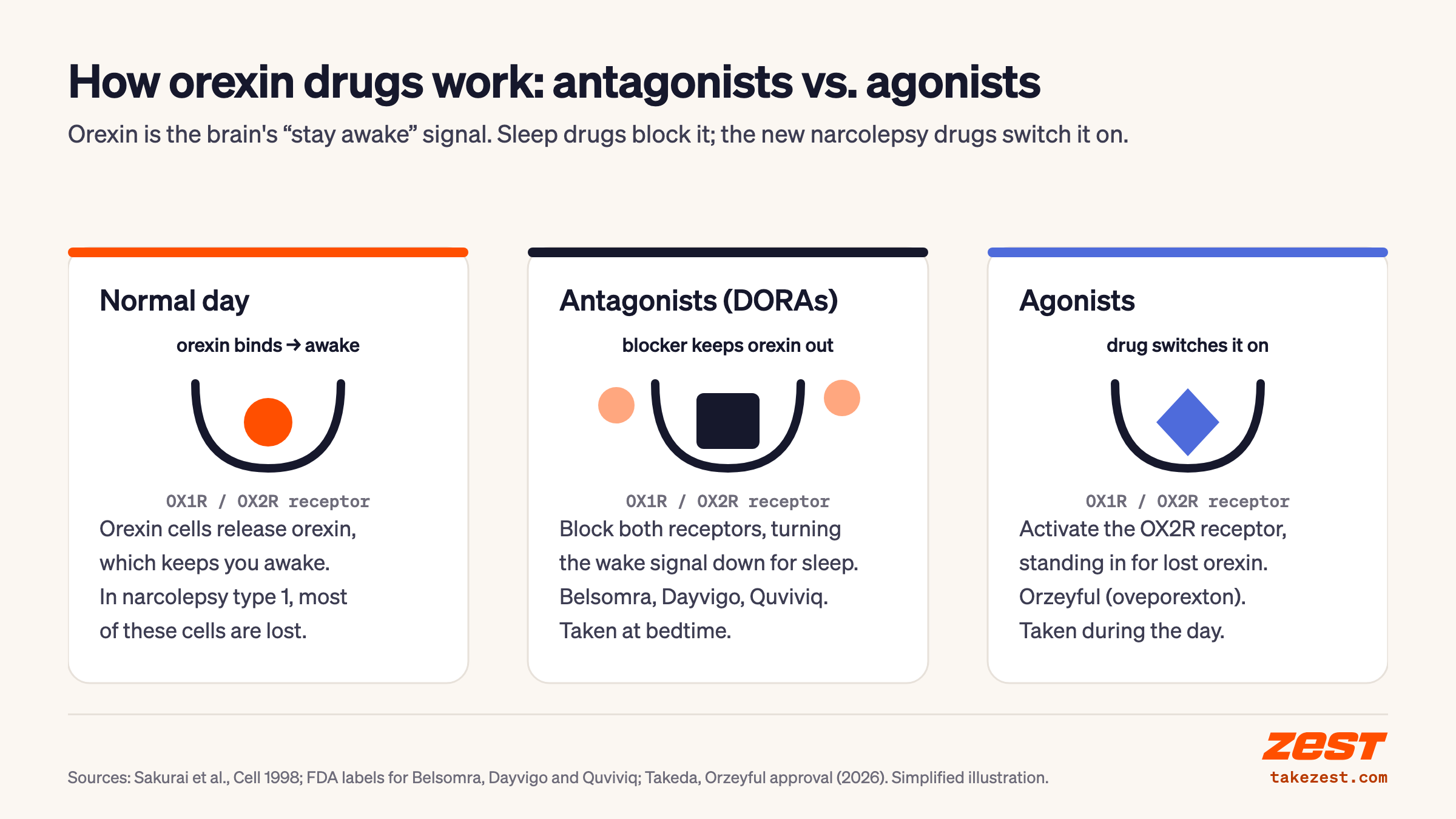
Orzeyful (oveporexton), from Takeda, was approved on August 5, 2026 for adults with narcolepsy type 1. It is the first orexin agonist, switching the orexin wake signal on directly. Read more in our guide to orexin agonists and Orzeyful.
Modafinil for "cognitive enhancement"
Some people without a sleep disorder use modafinil hoping to focus better. That is not an approved use, and the label says modafinil is not a replacement for sleep. The research is mixed. A 2015 systematic review of healthy, rested adults found improvements in executive function in most studies but less consistent effects on attention and memory. A 2019 meta-analysis of 19 placebo-controlled trials found a small overall effect and concluded there is only limited potential for modafinil as a cognitive enhancer outside sleep-deprived people. The label's risks apply to everyone who takes it.
How to get modafinil prescribed
Modafinil and armodafinil are controlled substances, so they need a prescription from a licensed clinician after an evaluation. Excessive sleepiness has many causes, and conditions such as narcolepsy or sleep apnea are usually confirmed with sleep testing. Good sleep habits come first, and for OSA, treating the airway comes first.
Zest RX for sleep. Zest is preparing to launch telehealth for sleep, connecting you with licensed providers who can evaluate whether a prescription option fits your needs. Join Zest RX early access.
Frequently asked questions
Is modafinil a controlled substance?
Yes. Modafinil and armodafinil are both DEA Schedule IV controlled substances, so they need a prescription. The labels note they can produce euphoric, stimulant-like effects and should be watched for misuse.
How long does modafinil last?
The FDA label gives an effective half-life of about 15 hours after repeated doses, with peak levels 2 to 4 hours after a dose. That is why it is taken in the morning, or before a night shift for shift work disorder.
Is modafinil a stimulant?
It is classed as a wake-promoting agent, not an amphetamine. The label says its effects resemble amphetamine and methylphenidate, though its pharmacology is not identical, and that it can produce stimulant-like psychoactive effects.
Modafinil vs. armodafinil: what is the difference?
Armodafinil is the R-form of modafinil, the part that lasts longer. Both have the same approved uses, warnings and Schedule IV status. Doses differ: 200 mg for modafinil and 150–250 mg for armodafinil.
Can you take modafinil with alcohol?
The Provigil Medication Guide says to avoid drinking alcohol because it is not known how alcohol will affect you while taking it. Ask your prescriber about your own situation.
Is there a generic for Provigil?
Yes. Drugs@FDA lists approved generic modafinil tablets from several manufacturers, and generic armodafinil is also approved. Generics contain the same active ingredient and carry the same warnings as the brand.
Sources
- PROVIGIL (modafinil) prescribing information and Medication Guide. DailyMed
- NUVIGIL (armodafinil) prescribing information. DailyMed
- WAKIX (pitolisant) prescribing information, Harmony Biosciences. DailyMed
- US Modafinil in Narcolepsy Multicenter Study Group. Randomized trial of modafinil for the treatment of pathological somnolence in narcolepsy. Ann Neurol. 1998;43(1):88-97. PubMed
- Czeisler CA, et al. Modafinil for excessive sleepiness associated with shift-work sleep disorder. N Engl J Med. 2005;353(5):476-486. PubMed
- Kuan YC, et al. Effects of Modafinil and Armodafinil in Patients With Obstructive Sleep Apnea: A Meta-analysis of Randomized Controlled Trials. Clin Ther. 2016;38(4):874-888. PubMed
- Battleday RM, Brem AK. Modafinil for cognitive neuroenhancement in healthy non-sleep-deprived subjects: A systematic review. Eur Neuropsychopharmacol. 2015;25(11):1865-1881. PubMed
- Kredlow MA, et al. The Efficacy of Modafinil as a Cognitive Enhancer: A Systematic Review and Meta-Analysis. J Clin Psychopharmacol. 2019;39(5):455-461. PubMed
- Dauvilliers Y, et al. Pitolisant versus placebo or modafinil in patients with narcolepsy: a double-blind, randomised trial. Lancet Neurol. 2013;12(11):1068-1075. PubMed
- Brown MB. Oveporexton: First Approval. Drugs. 2026. PubMed