Ramelteon (Rozerem): How It Works, Dosage, Side Effects and vs. Melatonin
Ramelteon (Rozerem) is a prescription melatonin receptor agonist approved for trouble falling asleep, and it is not a controlled substance. Here is how it works, how it is taken, what the trials found, its side effects, and how it compares with melatonin.


Rozerem is the brand name for ramelteon, a prescription sleep medication from Takeda approved by the FDA in 2005 for adults who have trouble falling asleep. Ramelteon is a melatonin receptor agonist: it acts on the same brain receptors as your own melatonin rather than sedating the brain. It is not a controlled substance.
Here is how ramelteon works, how it is taken, what the trials found, its side effects, and how it compares with melatonin supplements and other sleep medications. This is educational information, not medical advice; talk to a licensed clinician before starting or stopping any medication.
Rozerem at a glance
| Generic name | Ramelteon |
|---|---|
| Brand name | Rozerem (Takeda) |
| Drug class | Melatonin receptor agonist (MT1 and MT2) |
| FDA approval | July 22, 2005, for insomnia with trouble falling asleep |
| Controlled substance | No |
| Strengths | 8 mg tablet |
| Usual dose | 8 mg within 30 minutes of going to bed; no more than 8 mg a day |
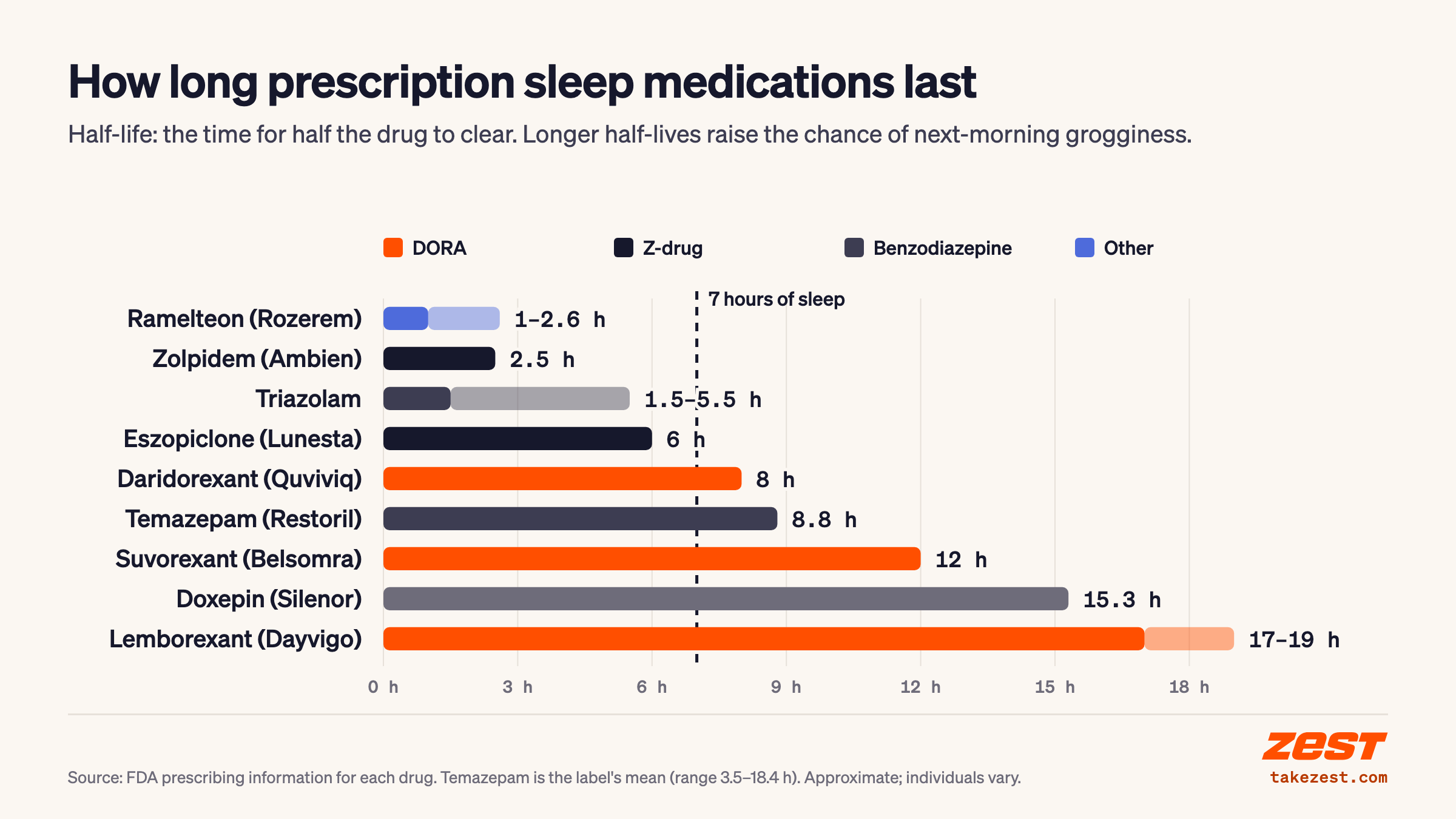
| Half-life | About 1 to 2.6 hours (its active breakdown product, 2 to 5 hours); peak levels about 45 minutes after a dose |
| Not for | People who have had angioedema (serious swelling) after taking it, and people taking fluvoxamine |
| Generic available | Yes |
How does ramelteon work?
Your brain releases melatonin in the evening, and it acts on two receptors, MT1 and MT2, that help run the body's 24-hour sleep-wake rhythm. Ramelteon binds strongly to both. The FDA label says it has no meaningful activity at the GABA receptor complex or at serotonin, dopamine, acetylcholine or opioid receptors.
That sets it apart from most sleep medications. Ambien (zolpidem) and benzodiazepines boost GABA, the brain's main "brake." Belsomra and the other dual orexin receptor antagonists (DORAs) block orexin, the signal that keeps you awake. Low-dose doxepin is thought to block histamine. For the orexin approach, see our guide to DORAs and daridorexant (Quviviq).
How to take Rozerem (dosage)
- The FDA label's recommended dose is 8 mg, taken within 30 minutes of going to bed. The total should not exceed 8 mg a day. In trials, 16 mg added no benefit for falling asleep.
- Don't take it with or right after a high-fat meal, which delays its peak by about 45 minutes.
- It should not be used with fluvoxamine, which raised ramelteon exposure about 190-fold. Use caution with other drugs that raise its levels, including ketoconazole, fluconazole, donepezil and doxepin. Rifampin can lower its effect. Tell your prescriber everything you take.
- It is not recommended for people with severe liver impairment and needs caution with moderate impairment.
- It is not recommended for people with severe sleep apnea.
- Do not drink alcohol with it. After taking it, stick to getting ready for bed.
Does ramelteon work? What the trials found
In a 5-week trial of 405 adults with chronic insomnia, published in 2007, the time to fall asleep in the sleep lab at week 1 was 32 minutes on 8 mg versus 48 minutes on placebo, and the improvement held at weeks 3 and 5. Ramelteon did not change time awake during the night or the number of awakenings, consistent with its approval for trouble falling asleep rather than staying asleep. There were no clinically meaningful next-morning effects and no rebound or withdrawal.
A 6-month trial of 451 adults, published in Sleep in 2009, found that 8 mg nightly consistently shortened the time to fall asleep in the lab at every check. Self-reported time to fall asleep improved significantly at week 1 and months 1 and 5. The FDA label adds one caution: in a similar outpatient study of adults under 65, ramelteon did not shorten self-reported time to fall asleep.
The American Academy of Sleep Medicine's 2017 guideline suggests ramelteon for trouble falling asleep in adults. It is a weak recommendation, meaning lower certainty.
Ramelteon side effects
From the label's placebo-controlled trials in 2,861 people with chronic insomnia:
| Side effect | Placebo | Rozerem 8 mg |
|---|---|---|
| Dizziness | 3% | 4% |
| Sleepiness | 2% | 3% |
| Fatigue | 2% | 3% |
| Nausea | 2% | 3% |
| Worse insomnia | 2% | 3% |
Rozerem has no boxed warning. The label's warnings:
- Severe allergic reactions: rare angioedema of the tongue or throat and anaphylaxis, sometimes after the first dose. Anyone who has this should not take it again.
- Complex sleep behaviors such as sleep-driving, plus hallucinations and other behavior changes. The label says to strongly consider stopping after any complex sleep behavior.
- Worsening depression or suicidal thoughts in some people.
- Next-day impairment: avoid driving or other hazardous activities after taking it.
- Hormone effects: lower testosterone and higher prolactin levels have been seen in adults.
- If insomnia lasts beyond 7 to 10 days of treatment, the label says you should be re-evaluated for another cause.
Stop and call your clinician if you notice any of the serious effects.
Ramelteon vs. melatonin
| Ramelteon (Rozerem) | Melatonin | |
|---|---|---|
| What it is | A prescription drug that activates melatonin receptors | The body's own sleep hormone, sold over the counter as a dietary supplement |
| FDA-approved for insomnia | Yes, trouble falling asleep | No |
| Prescription needed | Yes | No |
| AASM 2017 guideline for chronic insomnia | Suggests using (weak) | Suggests not using (weak) |
Both act on the MT1 and MT2 receptors. The difference is regulation and evidence: ramelteon went through FDA review for insomnia, and the 2017 guideline suggests it for trouble falling asleep while suggesting that clinicians not use melatonin for chronic insomnia.
Rozerem vs. other prescription sleep medications
| Medication | How it works | Approved for | Controlled |
|---|---|---|---|
| Rozerem (ramelteon) | Melatonin receptor agonist | Falling asleep | No |
| Ambien (zolpidem) | Boosts GABA | Falling asleep (short term) | Schedule IV |
| Belsomra (suvorexant) | Blocks orexin | Falling and/or staying asleep | Schedule IV |
| Silenor (low-dose doxepin) | Thought to block histamine | Staying asleep | No |
The right choice depends on whether your trouble is falling asleep, staying asleep or both, plus your health history and other medications. See our guides to low-dose doxepin for sleep and Ambien (zolpidem).
How to get Rozerem prescribed
Rozerem and generic ramelteon need a prescription from a licensed clinician after an evaluation of your sleep, health and medications. Good sleep habits and cognitive behavioral therapy for insomnia (CBT-I) remain the first step; medication works best alongside them.
Zest RX for sleep. Zest is preparing to launch telehealth for sleep, connecting you with licensed providers who can evaluate whether a prescription option fits your needs. Join Zest RX early access.
Frequently asked questions
Is ramelteon a controlled substance?
No. The FDA label states that Rozerem is not a controlled substance. In a study of people with a history of sedative misuse, doses up to 20 times the usual dose showed no signs of abuse potential compared with placebo.
Is ramelteon the same as melatonin?
No. Ramelteon is a prescription drug that activates the same MT1 and MT2 receptors as melatonin. It is FDA-approved for trouble falling asleep; melatonin is a supplement with no FDA approval for insomnia.
How long does ramelteon last?
Its half-life is short, about 1 to 2.6 hours, with an active breakdown product lasting 2 to 5 hours, according to the FDA label. It does not build up with nightly use.
What are the side effects of ramelteon?
The most common in trials were dizziness, sleepiness, fatigue, nausea and worse insomnia, each in 3 to 4% of people versus 2 to 3% on placebo. Rare serious effects include severe allergic swelling and complex sleep behaviors.
Can you take ramelteon with alcohol?
No. The label says not to drink alcohol with Rozerem, because the two can add to each other's effects on alertness and coordination, and alcohol may raise the risk of complex sleep behaviors.
Is there a generic for Rozerem?
Yes. The FDA has approved several generic ramelteon 8 mg tablets from different manufacturers. Rozerem itself is still marketed by Takeda. Generics contain the same active ingredient at the same 8 mg strength.
Sources
- ROZEREM (ramelteon) tablets prescribing information, Takeda. DailyMed
- Zammit G, et al. Evaluation of the efficacy and safety of ramelteon in subjects with chronic insomnia. J Clin Sleep Med. 2007;3(5):495-504. PubMed
- Mayer G, et al. Efficacy and safety of 6-month nightly ramelteon administration in adults with chronic primary insomnia. Sleep. 2009;32(3):351-360. PubMed
- Sateia MJ, et al. Clinical Practice Guideline for the Pharmacologic Treatment of Chronic Insomnia in Adults: An American Academy of Sleep Medicine Clinical Practice Guideline. J Clin Sleep Med. 2017;13(2):307-349. PubMed